

South Korea moves to shore up year-end exchange rate
South Korea moves to shore up year-end exchange rate
Posted December. 22, 2025 09:57,
Updated December. 22, 2025 09:57
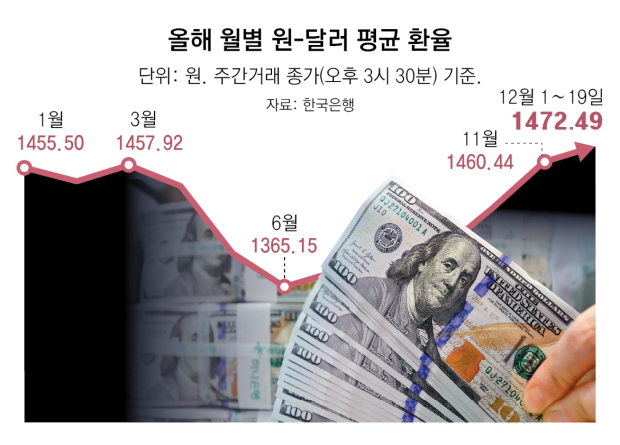
With six trading days remaining before the foreign exchange market closes for the year on Dec. 30, South Korea’s annual average exchange rate is projected to reach its highest level in 28 years, dating back to the Asian financial crisis. The government is reported to have adopted a policy of defending the year-end closing rate as firmly as possible during the remaining period to counter the sharp rise in the won-dollar exchange rate. The final closing rate is expected to hinge on large-scale currency hedging by the National Pension Service, as well as on whether exporting companies participate in the defensive effort.
According to the Bank of Korea on Dec. 21, the average won-dollar exchange rate from the beginning of the year through Dec. 19 stood at 1,421.16 won. That figure is 26.19 won higher than the 1998 annual average of 1,394.97 won, which was recorded in the aftermath of the foreign exchange crisis. The regular trading session on Dec. 19 closed at 1,476.3 won, and if the recent trend continues, it is widely viewed as nearly certain that this year’s annual average rate will settle in the 1,420-won range.
Last week, the government and the central bank announced measures to supply dollars to the market, including a temporary easing of foreign exchange soundness regulations, but the market response was muted. The exchange rate edged down slightly on Dec. 19 but turned higher again, ending overnight trading on Dec. 20 at 1,478.0 won as of 2 a.m.
The government is expected to mount an all-out effort ahead of the year-end market close to counter expectations that the exchange rate will continue to rise. The year-end closing rate has a significant impact on the financial soundness of companies and financial institutions that are sensitive to the dollar, including their debt ratios. It could also exert considerable influence on exchange rate movements and inflation in the first half of next year, from January through June. The won-dollar rate closed at 1,472.5 won on Dec. 30 last year, its highest level in 27 years since the end of 1997, when it reached 1,695.0 won, fueling market concerns.
Against this backdrop, the National Pension Service is expected to step up large-scale currency hedging through foreign exchange swaps with the central bank. Under the arrangement, the pension fund deposits won with the Bank of Korea and receives the dollars needed for overseas investment, reducing the need to purchase dollars directly in the market and thereby easing demand for the U.S. currency. At the end of last month, the government launched a four-party consultative body that includes the National Pension Service to advance exchange rate stabilization measures. On Dec. 16, the pension fund and the central bank agreed to extend their $65 billion foreign exchange swap contract by one year, through the end of next year.
Yoon Kyung-soo, director general of the Bank of Korea’s International Department, said on Dec. 19 that the foreign exchange swap with the National Pension Service has been partially resumed. He added that the pension fund is expected to manage its currency hedging more flexibly, a move that would likely increase the volume of swap transactions.
There is also speculation that dollars held by exporting companies could be released into the market this week under government pressure. On Dec. 18, presidential policy chief Kim Yong-beom convened executives from the country’s seven largest conglomerates for an emergency meeting on exchange rates and urged them to sell dollars promptly.
이호 기자 number2@donga.com






 About Dong-A Ilbo