

Korean tire makers expand into Eastern Europe
Korean tire makers expand into Eastern Europe
Posted February. 25, 2026 08:12,
Updated February. 25, 2026 08:12
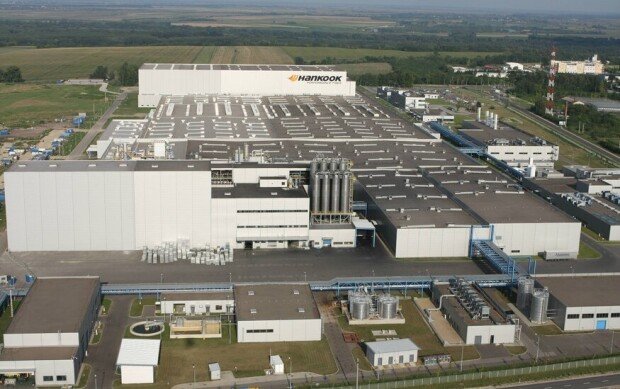
South Korea’s tire manufacturers are accelerating large-scale investments in Eastern Europe, aiming to turn the region into a new manufacturing hub. By leveraging relatively lower labor costs and other structural advantages, they seek to establish Eastern Europe as a strategic base for localizing production within the European market.
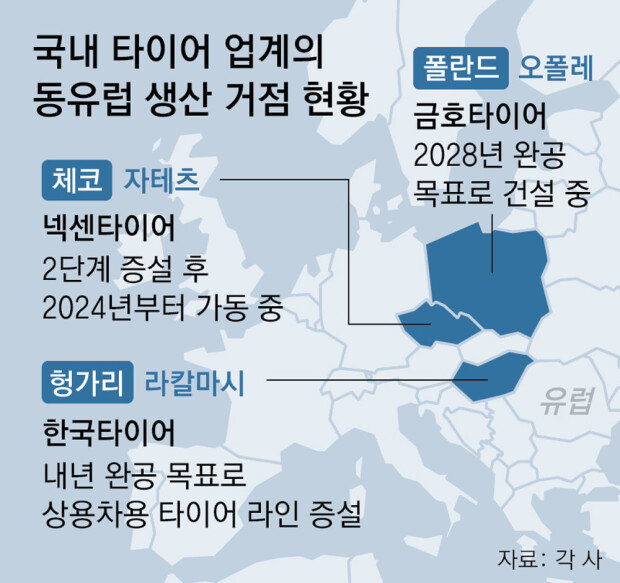
According to industry officials on Feb. 24, Kumho Tire has begun full-scale construction of a new plant in Opole, Poland, with operations slated to begin in August 2028. The facility will mark the company’s first production base in Europe, with total investment reaching $587 million. Once it is completed, all three of South Korea’s leading tire makers, Hankook Tire, Nexen Tire and Kumho Tire, will operate manufacturing plants in Eastern Europe.
Hankook Tire, which already runs a factory in Rácalmás, Hungary, is expanding its commercial vehicle tire production lines, with the project scheduled for completion next year. The company is investing about 540 million euros in the expansion. Nexen Tire also plans to lift the utilization rate at its plant in Žatec, the Czech Republic, from roughly 60 percent last year to full capacity this year.
Europe, widely regarded as the cradle of the automobile industry, remains a core market for global tire manufacturers. According to securities industry estimates, Europe accounted for more than 40 percent of total sales last year for both Hankook Tire and Nexen Tire, making it their largest regional market. Kumho Tire’s European sales, currently in the 20 percent range, are projected to climb into the 30 percent range once its Polish plant is completed. Analysts say that amid persistent geopolitical uncertainty and continued volatility in global supply chains, South Korean tire makers are moving to localize production in Europe rather than depend on maritime shipping to supply their largest market. Robust demand for high value-added products, including electric vehicle tires driven by carbon neutrality policies, has further strengthened Europe’s appeal.
Another factor behind the shift toward Eastern Europe is its comparatively lower labor costs. Industry officials also point to workforce stability, shaped in part by the region’s socialist legacy, as a competitive advantage. "In some Western European countries, workers frequently change jobs or leave without notice in search of higher daily wages, whereas employees in Eastern Europe tend to adhere more closely to workplace rules and contractual obligations," a tire industry official said.
최원영 o0@donga.com




![우유냐 두유냐…단백질 양 같아도 노령층엔 ‘이것’ 유리 [노화설계]](https://dimg.donga.com/c/138/175/90/1/wps/NEWS/IMAGE/2026/02/24/133411283.1.jpg)



 About Dong-A Ilbo