

Lee sets fuel price cap amid Middle East tension
Lee sets fuel price cap amid Middle East tension
Posted March. 10, 2026 08:04,
Updated March. 10, 2026 08:04
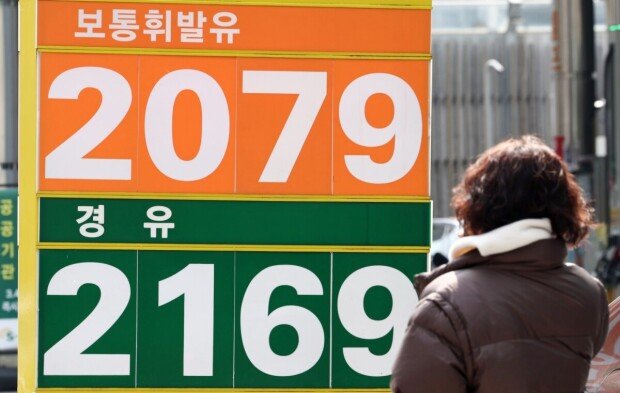
“We must prepare preemptive measures with firm resolve, keeping even the worst-case scenario in mind,” President Lee Jae-myung said Monday during an emergency economic review meeting. He stressed the need for swift government action as the war involving the United States, Israel and Iran shows signs of dragging on, warning that escalating tensions in the Middle East could increasingly spill over into financial markets and the broader economy.
At the meeting, the government outlined plans to introduce a maximum fuel price system as soon as this week, along with expanded fuel tax cuts and other measures aimed at stabilizing energy costs. Officials also said they could consider a supplementary budget focused on fuel expenses if the conflict continues.
● Fuel price cap to take effect this week
Kim Yong-beom, presidential chief of policy, told reporters after the meeting that the government is closely monitoring what he described as asymmetric pricing behavior in the fuel market.
“Oil refiners and gas stations tend to raise prices quickly when costs rise but lower them more slowly when costs fall,” Kim said. “Under the Petroleum Business Act, we will complete the necessary procedures, including issuing a government notice, so the maximum price system can be introduced within this week.”
President Lee also instructed officials to move quickly with the measure to improve predictability in gasoline and diesel prices.
The Petroleum Business Act allows the government to set maximum retail prices for refiners and fuel sellers when oil prices surge. If implemented, it would mark the first time in nearly three decades that authorities have applied such a measure to gasoline and diesel since oil price liberalization in 1997.
Kim said the system would likely operate on a two-week cycle. “If the ceiling is set based on prices before the current Middle East tensions emerged, the initial cap will likely be lower than the prices consumers are currently paying,” he said.
Lee also instructed officials to examine additional steps to ease the burden on households from rising fuel costs, including further fuel tax reductions and direct support for motorists, while leaving open the possibility of a supplementary budget focused on fuel prices.
Kim said the government’s top priority is ensuring that the South Korean economy weathers the crisis without significant damage. “Industries directly affected by the situation, as well as consumers, are facing mounting pressure, and a range of market measures must be considered,” he said. “If additional financial resources are required, that possibility must be seriously examined.”
Kim added that implementing the price cap could prove difficult if authorities remain constrained by the current budget ceiling. “Many new financial demands have emerged over the past 10 days,” he said.
Lee also called for strict action against those attempting to exploit market turmoil for unfair gains. Authorities will examine whether any factors are limiting market competition and investigate potential illegal activities such as collusion or tax evasion.
“To ensure the system functions effectively, relevant agencies will investigate possible collusion among refiners, examine gas station pricing, conduct tax inspections and carry out on-site checks to detect counterfeit petroleum products,” Kim said.
● Government may exercise priority purchase of crude
Kim also said South Korea could exercise priority purchasing rights for 20 million barrels of crude oil jointly stockpiled with oil-producing countries. “If we exercise the priority purchase option, we can take delivery of those 20 million barrels,” he said. “Crude produced overseas by the Korea National Oil Corp. could also be redirected to the domestic market.”
Currently, about 1.7 million barrels of crude imported daily by South Korea are affected by disruptions linked to the blockade of the Strait of Hormuz. The country holds roughly 190 million barrels in oil reserves, enough to last about 208 days.
Kim said the government will seek additional supplies from strategically aligned countries that do not require passage through the Strait of Hormuz. Over the longer term, South Korea plans to diversify its crude import sources beyond the Middle East.
Lee also called for proactive steps to address rising volatility in financial and foreign exchange markets, which he described as the lifeblood of the economy. He instructed officials to fully implement and expand the 100 trillion won market stabilization program announced at Friday’s special Cabinet meeting and stressed the need to prepare additional preemptive measures at both the government and central bank levels. Kim noted that the central bank plays a crucial role in stabilizing the government bond market.
Kyu-Jin Shin newjin@donga.com






 About Dong-A Ilbo